I've posted assignments for week sixteen. In the assignments, I've included notes on how to complete, format, and turn in your portfolio and a couple of last minute messages for the course.
As always, write with quesitons.
You've been great.
Steve
Monday, December 7, 2009

Monday, November 30, 2009
Class Climate Survey
Some time this week, you will receive an e-mail message in your JSRCC e-mail account from sender name "Class Climate Survey" inviting you to participate in an online survey. This is the college's request for you to evaluate my performance as your instructor. You will receive a separate e-mail message for each course section in which you are enrolled.
Each e-mail message contains a password-protected link to the online survey, specifically identifiable by instructor name, course number, and course section. By clicking this link, your password is automatically recognized, and you are able to respond anonymously to the survey.
The survey itself is very bare-boned, just fourteen questions, so please do it as soon as possible, and feel free to add commentary wherever possible. Thanks in advance for your participation.
Each e-mail message contains a password-protected link to the online survey, specifically identifiable by instructor name, course number, and course section. By clicking this link, your password is automatically recognized, and you are able to respond anonymously to the survey.
The survey itself is very bare-boned, just fourteen questions, so please do it as soon as possible, and feel free to add commentary wherever possible. Thanks in advance for your participation.
Portfolio due date changed. It is now: Tuesday, 15 December
I've moved your portfolio due date from Saturday, 12 December to Tuesday, 15 December. Please plan to have turned in your portfolio to me by Noon on the 15th, and I'll start grading them that afternoon. Of course, if you want to turn your portfolio in early, this is OK, but let me know via email. As the 15th approaches, I'll include details of how you can turn in your portfolio.
Essentially, there are two options for formating your portfolio: an e-portfolio or a physical portfolio. In the e-portfolio, you include an annotated list of hyperlinks to the works you want to include in the evidence section of your portfolio, and you post your cover essay as a blog post and as a .doc attachment in an email to me. Your cover essay is documented by links to the works to which you refer. With the physical portfolio, you turn in a file to me on the morning of the 15th. This file will contain your cover essay and evidence section. Most students document their essay by using short titles and page numbers of the hardcopy of their work, that is, the work to which they refer in the cover essay and which they then include with the essay in the evidence section of the portfolio.
If you want me to, please ask that I look at drafts, and feel free to ask questions. DO NOT PUT THIS PROGJECT OFF UNTIL THE DAY BEFORE IT IS DUE. If you haven't already, start collecting evidence and drafting sections of your portfolio. This week, I will require a paragraph level outline of your cover essay to be posted to your blog.
Essentially, there are two options for formating your portfolio: an e-portfolio or a physical portfolio. In the e-portfolio, you include an annotated list of hyperlinks to the works you want to include in the evidence section of your portfolio, and you post your cover essay as a blog post and as a .doc attachment in an email to me. Your cover essay is documented by links to the works to which you refer. With the physical portfolio, you turn in a file to me on the morning of the 15th. This file will contain your cover essay and evidence section. Most students document their essay by using short titles and page numbers of the hardcopy of their work, that is, the work to which they refer in the cover essay and which they then include with the essay in the evidence section of the portfolio.
If you want me to, please ask that I look at drafts, and feel free to ask questions. DO NOT PUT THIS PROGJECT OFF UNTIL THE DAY BEFORE IT IS DUE. If you haven't already, start collecting evidence and drafting sections of your portfolio. This week, I will require a paragraph level outline of your cover essay to be posted to your blog.
Assignments and Discussion Starters for Week 15 Are Posted.
Two more weeks. The second week of the course just doesn't seem that far behind us.
This week, you'll produce a paragraph level outline of your portfolio cover essay. You'll read and listen about the wide range of religious belief in America. In particular, I've concentrated on the religios beliefs of the founders in the personas of Jefferson, Patrick Henry, and Franklin, and I've concentrated on the Great Awakening--a period of intense religious ferver which preceeded the Revolution. The Great Awakening is represented by a sermon by Jonathan Edwards and a podcast on George Whitfield. You can think of these last two as the rock stars of their age. Woman fainted when they spoke. Men of good judgment gave all they had to charity. Remember Franklin's going to hear a preacher and first decding to give him the copper coins in his pocket but ending up giving all he had--including the gold? That was Whitfiled to whom Franklin was listening.
You'll also get to hear Enlightenment's take on Christian Religion. These will come in the form of Jefferson's "Statue for Religious Freedom" and Tom Paine's "Profession of Faith" in his Age of Reason. I know you'll be surprised to discover how seriously the founders took religion and the role they gave over to debate and discussion of religion as a means through which each individual could weed out superstition from true belief. If you want to get a handle on just how differently many founders viewed Christianity, google "The Jefferson Bible."
Your blog post for the week will have you writing your own profession of faith--a la Paine, and a discussion thread will have you attempting to track down religious believes you--as a class--share in common. This last discussion should give you some idea of the problem religious diversity was to the founders. How do you bring together colonies, many of whom had state sanctioned religions? As you read, listen, and write this week, begin thinking of the "Right to Religious Freedom" and "separation of church and state" as brilliant solutions of building a shared sense of political nationalism among diverse states and people.
As always, write with questions.
Steve
As you read these different accounts,
This week, you'll produce a paragraph level outline of your portfolio cover essay. You'll read and listen about the wide range of religious belief in America. In particular, I've concentrated on the religios beliefs of the founders in the personas of Jefferson, Patrick Henry, and Franklin, and I've concentrated on the Great Awakening--a period of intense religious ferver which preceeded the Revolution. The Great Awakening is represented by a sermon by Jonathan Edwards and a podcast on George Whitfield. You can think of these last two as the rock stars of their age. Woman fainted when they spoke. Men of good judgment gave all they had to charity. Remember Franklin's going to hear a preacher and first decding to give him the copper coins in his pocket but ending up giving all he had--including the gold? That was Whitfiled to whom Franklin was listening.
You'll also get to hear Enlightenment's take on Christian Religion. These will come in the form of Jefferson's "Statue for Religious Freedom" and Tom Paine's "Profession of Faith" in his Age of Reason. I know you'll be surprised to discover how seriously the founders took religion and the role they gave over to debate and discussion of religion as a means through which each individual could weed out superstition from true belief. If you want to get a handle on just how differently many founders viewed Christianity, google "The Jefferson Bible."
Your blog post for the week will have you writing your own profession of faith--a la Paine, and a discussion thread will have you attempting to track down religious believes you--as a class--share in common. This last discussion should give you some idea of the problem religious diversity was to the founders. How do you bring together colonies, many of whom had state sanctioned religions? As you read, listen, and write this week, begin thinking of the "Right to Religious Freedom" and "separation of church and state" as brilliant solutions of building a shared sense of political nationalism among diverse states and people.
As always, write with questions.
Steve
As you read these different accounts,
Tuesday, November 24, 2009
Alexander Hamilton Rap...And Now, For Something Completely Different.
Once again proving that the contempoary world's power is too rich and has way, way too much leisure, here is Lin-Manuel Miranda as he performs at the White House Poetry Jam. The piece is, of course, his "Alexander Hamilton Rap." For those who don't know who Hamilton and Aaron Burr are, you can read about them by following the links. Burr kills Hamilton in a duel in 1804 over a series of insults. If you are interested in how such could happen, look up the code duello.
Happy Thanksgiving...Read Washington's Original Proclaimation of the Holiday
http://www.leaderu.com/humanities/washington-thanksgiving-original.html
Once again, we have Katthar to thank for finding an interesting tidbit of literature. It is the original proclamation of George Washington (1789--the year following the adoption of our current Constitution), where he proclaims the first "official" Thanksgiving for the country. It's a cutting from the original newspaper announcement, so you'll also get to see what a newspaper article looked like in 1789.
I remember at least one of you being very excited about the religious leanings of the founders, so you should enjoy this almost prayer. Washington was much more of a recognizable Christian to modern readers than many of the early founders. For instance, this proclamation has a very different character from the religious writings of, say, Tom Paine or Thomas Jefferson, but you should make sure to look for the absence of the word, "God." Franklin, as you read, was always cagey about his religion, but it looks as if he was, at least until late in life, a Deist. Following break, you'll get to read something about the country's early religious life. Did you know that Jefferson was pubically accused of being an Atheist, and many of the most religious Puritan descendents actually hid their Bibles when he was elected president, because they thought he would use his position to impose Atheism as an official, state religio?. If not, check out the pages surrounding Jefferson from Colonial Williamsbugh. The links are on the extra-credit page, and look under the election of 1801.
You should also note that this is the period between the adoption of the Constitution (1787) and the adoption of the Bill of Rights (1791). It is the Bill of Rights which guarantees freedom of religion and separation of church and state. The upshot? The government favoring one set of religious ideas over another was *much* easier in this period just before the adoption of the Bill of Rights.
Steve
Once again, we have Katthar to thank for finding an interesting tidbit of literature. It is the original proclamation of George Washington (1789--the year following the adoption of our current Constitution), where he proclaims the first "official" Thanksgiving for the country. It's a cutting from the original newspaper announcement, so you'll also get to see what a newspaper article looked like in 1789.
I remember at least one of you being very excited about the religious leanings of the founders, so you should enjoy this almost prayer. Washington was much more of a recognizable Christian to modern readers than many of the early founders. For instance, this proclamation has a very different character from the religious writings of, say, Tom Paine or Thomas Jefferson, but you should make sure to look for the absence of the word, "God." Franklin, as you read, was always cagey about his religion, but it looks as if he was, at least until late in life, a Deist. Following break, you'll get to read something about the country's early religious life. Did you know that Jefferson was pubically accused of being an Atheist, and many of the most religious Puritan descendents actually hid their Bibles when he was elected president, because they thought he would use his position to impose Atheism as an official, state religio?. If not, check out the pages surrounding Jefferson from Colonial Williamsbugh. The links are on the extra-credit page, and look under the election of 1801.
You should also note that this is the period between the adoption of the Constitution (1787) and the adoption of the Bill of Rights (1791). It is the Bill of Rights which guarantees freedom of religion and separation of church and state. The upshot? The government favoring one set of religious ideas over another was *much* easier in this period just before the adoption of the Bill of Rights.
Steve
Wednesday, November 18, 2009
Assignments for weeks thirteen and fourteen are posted.
I've tried to keep the reading this week focused on the literature surrounding the Thanksgiving Holiday. You have the only two paragraphs which record the 1621 Pilgram Thanksgiving, an address from an Indian Thanksgiving ceremony, and Fanny Fern's description of an 1853 Thanksgiving Day.
I've intentionally keep the reading and writing short, so you can enjoy your Fall break. I thought the reading would give you a deeper appreciation for the holiday, and it might give you some good dinner conversation if you happen to find yourself with friends and family reproducing the 1621 feast.
Enjoy your break, but do do the work.
I've intentionally keep the reading and writing short, so you can enjoy your Fall break. I thought the reading would give you a deeper appreciation for the holiday, and it might give you some good dinner conversation if you happen to find yourself with friends and family reproducing the 1621 feast.
Enjoy your break, but do do the work.
Tuesday, November 17, 2009
Please get in touch if you need me today, Tuesday, 17 November
While I won't be keeping physical office hours or holding physical classes today, I am no longer sick. I'm sitting out the 24 hours post fever recommended in the guidelines for H1N1 to make sure I'm not contagious. I'll be at home working on the computer, and I'll be happy to respond to email or phone calls, 262-8585, that is, if you have any questions or concerns.
Steve
Monday, November 16, 2009
Your assignments this week will be a day late...
The good news: I'll resume my regular office hours on Wednesday.
The bad news: According to the doctor, my symptoms for the past week are consistant with H1N1, so I'm home until 24 hours after my last fever, which returned Sunday afternoon and evening. I'm feeling much better, but being sick has put me behind, so expect your assignments for the coming week to be posted tomorrow rather than today, Monday, 16 November.
Steve
The bad news: According to the doctor, my symptoms for the past week are consistant with H1N1, so I'm home until 24 hours after my last fever, which returned Sunday afternoon and evening. I'm feeling much better, but being sick has put me behind, so expect your assignments for the coming week to be posted tomorrow rather than today, Monday, 16 November.
Steve
Wednesday, November 11, 2009
Office hours cancelled, Wednesday, Nov. 11
Folks. No office hours today, not even virtual. I am not feeling well, and the only thing I'm planning to do is head to the doctors.
Steve
Steve
Monday, November 9, 2009
Assignments for Week Twelve Are Posted.
Enjoy.
In the first week of most literature courses I teach, students play musical chairs. It is a fun way for the class to get to know one another; but, being a teacher, I have a more sinister purpose in mind. People can learn a lot from kid's games and children's literature. Of all the texts constructed by a society, those meant for children give the most clear views of values, social roles, and fears of a society. Musical chairs is no exception. It is the perfect capitalist game.
Think about it. It is a game where a community of people, usually children, calmly compete for limited resources; indeed, as each round completes and the loser leaves the circle to watch from the sidelines, another chair is removed to ensure the game continues its focus on smaller-and-smaller resources and the group of losers gets larger and larger, until there is only one "winner." It is about this point that I introduce the concepts of cultural knowledge and zero-sum games. Cultural knowledge is that body of knowledge and conventions you can pretty much count on those in a community having. The range of "stuff" or, to borrow Sherlock Holmes' term, "the ineffectual furniture" we carry around is enormous, but it is part of our cultural identity and part of how we make sense of the world.
Early in our culture, we are given the cultural knowledge of how to play musical chairs, and whether we use it or not we carry this knowledge around for most of the remainder of our life. Since musical chairs is a game, and games are by definition in our culture fun, we don't worry about what our three and four year old selves absorb alongside of the knowledge of how to play the game; however, musical chairs taught us a number of lessons people need to know about how capitalists look at resources and establish and maintain power among ourselves.
Think about it: In the cut throat world of the business world and that of musical chairs, resources are always limited. One must compete for these resources and take them from others to succeed. There can be only one winner. Competition is fun. The winner should be honored. One must learn to win and loose gracefully. For there to be a winner, there must be a looser. ...I could go on.
In the classroom, I change one rule in the second game of musical chairs which we play. In specific, I make it a rule that no one can be eliminated, and every one must find a seat on an other's lap if a chair isn't present. As resources get scarce, soon there is a lot of laughter, and there's a lot of negotiation, especially as we get down to two, then one, then no chairs, and the rules remain in force.
This exercise is meant to teach college students the difference that critical thinking, interpretation, and even the simplest of revisions can make in how a text is used in society--that is, the cultural work a text--like the game musical chairs--is allowed to do. More important, it is means to show students that we control how texts get used and interpreted, and interpretations matter. We need to fight to establish and circulate the best and most useful. Changing a single rule in how to interpret a text, like changing one rule in musical chairs, changes the cultural work a text does from teaching rather sinister lessons in cut-throat competition in a world of win or loose and dwindling resources into a text which can teach kids lessons in group problem solving and the fact there are always ways around problems of dwindling resources, that is, if people are willing and able to talk, negotiate, and think outside the ways things have always been done.
Last week, you got a little taste of all of the power of revision and taking the time to work critical documents through multiple drafts and readers. You looked at how the Declaration and the Constitution came into being as drafts, were discussed, revised, and then sold to the American people. Think how different our lives would have been if Franklin hasn't have been on the committee which drafted the Declaration. An article on Franklin's role describes his work as:
" He crossed out, using the heavy backslashes that he often employed, the last three words of Jefferson's phrase "We hold these truths to be sacred and undeniable" and changed them to the words now enshrined in history: "We hold these truths to be self-evident."
The idea of "self-evident" truths was one that drew less on Locke, who was Jefferson's favored philosopher, than on the scientific determinism espoused by Isaac Newton and the analytic empiricism of Franklin's close friend David Hume. In what became known as "Hume's fork," the great Scottish philosopher had developed a theory that distinguished between "synthetic" truths that describe matters of fact (such as "London is bigger than Philadelphia") and "analytic" truths that are so by virtue of reason and definition ("the angles of a triangle total 180 degrees"; "all bachelors are unmarried"). Hume referred to the latter type of axioms as "self-evident" truths. By using the word "sacred," Jefferson had implied, intentionally or not, that the principle in question—the equality of men and their endowment by their creator with inalienable rights—was an assertion of religion. Franklin's edit turned it instead into an assertion of rationality." (http://www.time.com/time/2003/franklin/bfdeclaration2.html)
On reason I build in exercise that encourage you to revise your work is to give you insight into what the phrase, "pursue happiness," means, and a lot of it has to do with revision of your self and how you look at life. We talk about American being the land of opportunities. One opportunity is to re-write yourself. The serf which comes to America no longer has to work all their lives paying rent and their surplus to a rich landowner. If they don't like the relationship their boss demands, they can "vote with their feet" or they can tell their boss off. Someone coming from an authoritative nation doesn't have to accept being intimidated or beat up by the authorities, Here, if police beat you up, you have recourse to laws and procedures which have a reasonable chance of producing justice. If you come here ignorant, we have schools. The list goes on, but the point is that one of the often undersold but essential aspects of America is that it is a place which encourages you to revise the text of yourself.
Think back to Emerson and Thoreau. Both Romantic authors wanted you to "get in touch" with your "best, truest self," and they wanted you to edit your life. Like most good editors, they wanted you to look at how cluttered your live was and toss out anything which wasn't necessary to your real purpose. This is a long, long way from Medieval ideas that one is born into a Great Chain of Being, and one accepts one's place in it. According to this view, if one is born a serf, then one works to be the best serf possible. One of the main reasons for America's success is that we've encouraged an ever greater percentages of the population to define their selves for them selves. We tell our kids to reach for their dreams, dream big, and to develop their potential. We're still riding the last gasps of the economic surges which resulted from opening up the franchise to women, encouraging the working class to get college degrees, and then opening up college to minorities and women. Make no mistake, in the process of opening up our society to others and helping them to pursue happiness and become their best, we reap the benefit of a hugely expanded pool of talent. From this talent comes innovation and the scrambling energy to be better which drives our economy. This is why I always laugh when the current generations--I've lived through three now--trot out the old arguments and rhetorics about immigration.
Among the old chestnuts is that America is a land of immigrants. True, but the ramification of this realization is that our economy has been driven by the contributions of immigrants becoming American. Another of those old, rhetorical chestnuts has those immigrants behaving in "Un-American" ways and "taking jobs and resources" from "Real Americans." What is odd is that every generation is an immigrant to America, as every generation discovers, re-writes them selves, and gets rewritten by the society and the land they find on their arrival.
American is the land of opportunity, a land where the people are always revisiting the rules in light of new insights, and the success of everyone depends on the maximum number being given the chance to revise and rewrite their lives as pursuers of happiness. This is the central reason that our founders spent so much time talking about how to become "healthy, wealthy, and wise."
The Enlightenment not only revised and rewrote the rules on how to set up government and on the correct relationship between the state and the individual, Enlightenment thinkers wrote and rewrote a host of texts on rewriting and revising the self, so the maximum number of "selves" possible would be ready to become part of the new and improved government, that one which was "by the people and for the people." America is, hence, also the land of self-help.
This week is about getting your head around the self-help literature of the Enlightenment. Then, the idea that the common person could revise their own lives was brand, spanking new. This week is about revisiting the central text of your life--yourself, but doing so using the reason, the careful observation, the communal feedback, and the common sense the Enlightenment so valued. You make the judgments about what the good life looks like. You make the judgment about what constitutes well-being, but Americans will give you a hard time if you aren't perceived as pursuing happiness and making yourself better.
Life may be one large game of musical chairs, but in the American version of the game, you get to talk to the other players and decide how you will play the game and by which rules. In the process, you get to decide what work your life, the game, and your fellow players will do in and for society. Zero-sum games maximize losers. They are sucker's games. The belief that all are created equal and all have the inherent right to pursue happiness is a winner's game. It recognizes that it is the players who understand why the games are being played that have the best chance of maximizing winners and human potential. To maximize human potential--the dream shared by Romantic and Enlightenment Thinker alike--you win by first creating the competition and yourself as the best player possible.
In the first week of most literature courses I teach, students play musical chairs. It is a fun way for the class to get to know one another; but, being a teacher, I have a more sinister purpose in mind. People can learn a lot from kid's games and children's literature. Of all the texts constructed by a society, those meant for children give the most clear views of values, social roles, and fears of a society. Musical chairs is no exception. It is the perfect capitalist game.
Think about it. It is a game where a community of people, usually children, calmly compete for limited resources; indeed, as each round completes and the loser leaves the circle to watch from the sidelines, another chair is removed to ensure the game continues its focus on smaller-and-smaller resources and the group of losers gets larger and larger, until there is only one "winner." It is about this point that I introduce the concepts of cultural knowledge and zero-sum games. Cultural knowledge is that body of knowledge and conventions you can pretty much count on those in a community having. The range of "stuff" or, to borrow Sherlock Holmes' term, "the ineffectual furniture" we carry around is enormous, but it is part of our cultural identity and part of how we make sense of the world.
Early in our culture, we are given the cultural knowledge of how to play musical chairs, and whether we use it or not we carry this knowledge around for most of the remainder of our life. Since musical chairs is a game, and games are by definition in our culture fun, we don't worry about what our three and four year old selves absorb alongside of the knowledge of how to play the game; however, musical chairs taught us a number of lessons people need to know about how capitalists look at resources and establish and maintain power among ourselves.
Think about it: In the cut throat world of the business world and that of musical chairs, resources are always limited. One must compete for these resources and take them from others to succeed. There can be only one winner. Competition is fun. The winner should be honored. One must learn to win and loose gracefully. For there to be a winner, there must be a looser. ...I could go on.
In the classroom, I change one rule in the second game of musical chairs which we play. In specific, I make it a rule that no one can be eliminated, and every one must find a seat on an other's lap if a chair isn't present. As resources get scarce, soon there is a lot of laughter, and there's a lot of negotiation, especially as we get down to two, then one, then no chairs, and the rules remain in force.
This exercise is meant to teach college students the difference that critical thinking, interpretation, and even the simplest of revisions can make in how a text is used in society--that is, the cultural work a text--like the game musical chairs--is allowed to do. More important, it is means to show students that we control how texts get used and interpreted, and interpretations matter. We need to fight to establish and circulate the best and most useful. Changing a single rule in how to interpret a text, like changing one rule in musical chairs, changes the cultural work a text does from teaching rather sinister lessons in cut-throat competition in a world of win or loose and dwindling resources into a text which can teach kids lessons in group problem solving and the fact there are always ways around problems of dwindling resources, that is, if people are willing and able to talk, negotiate, and think outside the ways things have always been done.
Last week, you got a little taste of all of the power of revision and taking the time to work critical documents through multiple drafts and readers. You looked at how the Declaration and the Constitution came into being as drafts, were discussed, revised, and then sold to the American people. Think how different our lives would have been if Franklin hasn't have been on the committee which drafted the Declaration. An article on Franklin's role describes his work as:
" He crossed out, using the heavy backslashes that he often employed, the last three words of Jefferson's phrase "We hold these truths to be sacred and undeniable" and changed them to the words now enshrined in history: "We hold these truths to be self-evident."
The idea of "self-evident" truths was one that drew less on Locke, who was Jefferson's favored philosopher, than on the scientific determinism espoused by Isaac Newton and the analytic empiricism of Franklin's close friend David Hume. In what became known as "Hume's fork," the great Scottish philosopher had developed a theory that distinguished between "synthetic" truths that describe matters of fact (such as "London is bigger than Philadelphia") and "analytic" truths that are so by virtue of reason and definition ("the angles of a triangle total 180 degrees"; "all bachelors are unmarried"). Hume referred to the latter type of axioms as "self-evident" truths. By using the word "sacred," Jefferson had implied, intentionally or not, that the principle in question—the equality of men and their endowment by their creator with inalienable rights—was an assertion of religion. Franklin's edit turned it instead into an assertion of rationality." (http://www.time.com/time/2003/franklin/bfdeclaration2.html)
On reason I build in exercise that encourage you to revise your work is to give you insight into what the phrase, "pursue happiness," means, and a lot of it has to do with revision of your self and how you look at life. We talk about American being the land of opportunities. One opportunity is to re-write yourself. The serf which comes to America no longer has to work all their lives paying rent and their surplus to a rich landowner. If they don't like the relationship their boss demands, they can "vote with their feet" or they can tell their boss off. Someone coming from an authoritative nation doesn't have to accept being intimidated or beat up by the authorities, Here, if police beat you up, you have recourse to laws and procedures which have a reasonable chance of producing justice. If you come here ignorant, we have schools. The list goes on, but the point is that one of the often undersold but essential aspects of America is that it is a place which encourages you to revise the text of yourself.
Think back to Emerson and Thoreau. Both Romantic authors wanted you to "get in touch" with your "best, truest self," and they wanted you to edit your life. Like most good editors, they wanted you to look at how cluttered your live was and toss out anything which wasn't necessary to your real purpose. This is a long, long way from Medieval ideas that one is born into a Great Chain of Being, and one accepts one's place in it. According to this view, if one is born a serf, then one works to be the best serf possible. One of the main reasons for America's success is that we've encouraged an ever greater percentages of the population to define their selves for them selves. We tell our kids to reach for their dreams, dream big, and to develop their potential. We're still riding the last gasps of the economic surges which resulted from opening up the franchise to women, encouraging the working class to get college degrees, and then opening up college to minorities and women. Make no mistake, in the process of opening up our society to others and helping them to pursue happiness and become their best, we reap the benefit of a hugely expanded pool of talent. From this talent comes innovation and the scrambling energy to be better which drives our economy. This is why I always laugh when the current generations--I've lived through three now--trot out the old arguments and rhetorics about immigration.
Among the old chestnuts is that America is a land of immigrants. True, but the ramification of this realization is that our economy has been driven by the contributions of immigrants becoming American. Another of those old, rhetorical chestnuts has those immigrants behaving in "Un-American" ways and "taking jobs and resources" from "Real Americans." What is odd is that every generation is an immigrant to America, as every generation discovers, re-writes them selves, and gets rewritten by the society and the land they find on their arrival.
American is the land of opportunity, a land where the people are always revisiting the rules in light of new insights, and the success of everyone depends on the maximum number being given the chance to revise and rewrite their lives as pursuers of happiness. This is the central reason that our founders spent so much time talking about how to become "healthy, wealthy, and wise."
The Enlightenment not only revised and rewrote the rules on how to set up government and on the correct relationship between the state and the individual, Enlightenment thinkers wrote and rewrote a host of texts on rewriting and revising the self, so the maximum number of "selves" possible would be ready to become part of the new and improved government, that one which was "by the people and for the people." America is, hence, also the land of self-help.
This week is about getting your head around the self-help literature of the Enlightenment. Then, the idea that the common person could revise their own lives was brand, spanking new. This week is about revisiting the central text of your life--yourself, but doing so using the reason, the careful observation, the communal feedback, and the common sense the Enlightenment so valued. You make the judgments about what the good life looks like. You make the judgment about what constitutes well-being, but Americans will give you a hard time if you aren't perceived as pursuing happiness and making yourself better.
Life may be one large game of musical chairs, but in the American version of the game, you get to talk to the other players and decide how you will play the game and by which rules. In the process, you get to decide what work your life, the game, and your fellow players will do in and for society. Zero-sum games maximize losers. They are sucker's games. The belief that all are created equal and all have the inherent right to pursue happiness is a winner's game. It recognizes that it is the players who understand why the games are being played that have the best chance of maximizing winners and human potential. To maximize human potential--the dream shared by Romantic and Enlightenment Thinker alike--you win by first creating the competition and yourself as the best player possible.
Virtual Office Hours, Monday, 9 November.
Good morning,
I won't be holding physical office hours today; however, you can catch me at home via the direct number, 262-8585.
My wife came home Friday afternoon with the symptoms of a cold/flu. She never showed a fever, and--since she is a health care worked--she's had both the flu vacines/nasal sprays--we're assuming its a cold. By Saturday afternoon, I was showing symptoms myself, and I don't feel well at all this morning.
Having said this, please do feel free to get in touch with me at the number listed above or by email. I hate being sick. I spend most of the time bored, so I'll welcome hearing from you with a good question. If you need the help, we can use google docs and the class website to collaborate.
Finally, please keep an eye on this spot. If I need to cancel classes on Tuesday, I will do so here. As of right now, I suspect I'll be in to teach.
Steve
I won't be holding physical office hours today; however, you can catch me at home via the direct number, 262-8585.
My wife came home Friday afternoon with the symptoms of a cold/flu. She never showed a fever, and--since she is a health care worked--she's had both the flu vacines/nasal sprays--we're assuming its a cold. By Saturday afternoon, I was showing symptoms myself, and I don't feel well at all this morning.
Having said this, please do feel free to get in touch with me at the number listed above or by email. I hate being sick. I spend most of the time bored, so I'll welcome hearing from you with a good question. If you need the help, we can use google docs and the class website to collaborate.
Finally, please keep an eye on this spot. If I need to cancel classes on Tuesday, I will do so here. As of right now, I suspect I'll be in to teach.
Steve
Wednesday, November 4, 2009
Extra Credit and Announcements
Katthar is racking up the extra credit, and I don't mind giving it out. Everything he's done will help you learn, and it sounds like fun.
- This Saturday, between 10:00 and 5:00, stop by and get a Gyro, lamb sandwich, etc. at the Marketplace on 17th Street. You'll get extra credit for meeting another class mate at an historical location. Katthar is cooking. To find Katthar and to score your favorite sandwich, look for Eastern Star Catering. Katthar is, as I said, the cook. He's also the guy with long hair. What? You didn't know that Richmond has an historic Farmer's Market. It has been meeting since 1737, and it's at the heart of a few other possible extra-credit opportunities about or on Church Hill.
- While at the Farmer's Market, you might also want to walk the three blocks to the spot on 14th Street where Virginia passed the Statue of Religious Freedom. Visiting is on the extra-credit list for Thomas Jefferson. Here's a review and pictures from Katthar's Blog.
- Since you might well be near Church Hill anyway, you might want to drive a few blocks and see where Patrick Henry gave the famous "Give Me Liberty or Give Me Death Speech," or you might stop by the Poe Museum or the cemetery where one of Poe's loves is buried. Katthar found a legal recording, and I've uploaded it to the extra-credit page. I've even set it up, so you can listen to the speech as you look over your extra-credit options. Look just below the Patrick Henry section.
- What? You are going to miss the chance to meet Katthar, get some good Middle Eastern food, meet fellow classmates, and get your own extra-credit. Katthar still have you covered, this week he found a recording of Patrick Henry's speech. I'll soon have it uploaded for your listening pleasure, and he found a recording of Franklin's "Speech to the Constitutional Congress." I've uploaded the last to this week's assignment page. Look at the very bottom of the page to find it.
As always, write with questions. The college and I cannot and do not take responsibility for anything which might happen on an extra-credit outing. Remember, these are extra-credit options, and are not required for successful completion of the course. Still, they sound like fun, and who knows? You might get a chance to meet yours truly. I've never knowingly not gotten a gyro, history, and the week's veggie shopping done--especially when I can fit it into one outing.
Post Script...If I'm counting correctly, Katthar may just may max out his extra-credit on Saturday. This means he'll be in for almost a two letter grade addition to his final grade for the course. He's more than earned it, as I've rarely been able to offer a learning opportunity like this to students. Then again, I never thought of a student catering an event at one of the extra-credit locations. Katthar...you've done a fine job, and I think you can also bank on a high class participation grade.
The committees of correspondence have been updated
At the sixty percent point of the semester, that is, 2 November, professors go through and look at who has been participating and who has not. In an online couse, non-particpation means not participating for three weeks or more, so 12 October was the cut-off date for this semester.
This moment also gives me a chance to consolidate groups, trimming them down to those who did not drop the class early on and those who are keeping up with the work.
Take a moment and introduce yourself to your new group members and to read some of their work.
Write with questions.
Steve
This moment also gives me a chance to consolidate groups, trimming them down to those who did not drop the class early on and those who are keeping up with the work.
Take a moment and introduce yourself to your new group members and to read some of their work.
Write with questions.
Steve
Monday, November 2, 2009
Assignments for Week Eleven Are Posted
 This week we take a step back in time, moving from the struggles of the Antebellum period and the Civil War to the Revolution and the birth of the New Republic. G
In the process, we step firmly into what is called the Age of Enlightenment and into a period where the Romanticism of Thoreau, Emerson, Jacobs, etc. didn't have a name and the philosophical thought which gave birth to it was distrusted, because the Enlightenment period--roughly 1688-1820--had learned to distrust the excesses of religious and emotional passion. It had good reasons to distrust how groups and individuals acted under the influence of high emotion.
The Age of Enlightenment period grew out of the best and the worst of the Renaissance. On the one hand, the Enlightenment inherited a world where old institutions were beginning to crumble and where a few, select individuals had the chance to gain social mobility. Captain John Smith is a good example of someone who didn't start from the nobility but was able to cobble together an extraordinary life from the social mobility allowed by the late Renaissance. The Enlightenment also grew out of an era where the printing press allowed classical texts once thought lost to be published and to begin gaining wide circulation. The presses allowed mathematical tables, pictures, and individual observations--the stuff of science--to find a wider audience and, hence, to tap into the interests of a wider pool of talent.
The Age of Enlightenment grew out of an era where Humanistic scholarship, with it's focus on figuring out what an author meant to say and on clear writing, was replacing the Scholastic movement, with it's focus on establish authorities, how the Roman and Greek Pagan Masters "fit" into the Christian world view, and on jargon.
The Enlightenment grew out of a period of exploration and discovery, which showed new ways of living in the Orient, Africa, and the New World, and--in the process--produced the largest English vocabulary in the history of the language. Why? Because society needed these new words to cover old concepts, those being introduced by the wider circulation of knowledge in Europe, and to cover introduced concepts from around the world. In short, the Enlightenment grew out of a period of change, more change than Europe had seen for almost a thousand years.
However, with change comes conflict; this is othe other hand. There's an a Chinese curse which goes, "May you live in interesting times." The Renaissance--the re-birth of European thought--was a period of international strife and struggle caused by the change inherent in incorporating so many new ideas, institutions, and changes into a short time.
Religious wars abounded in the Renaissance. The Protestant Revolution and the Reformation swept new ideas into being and challenged the old, Medieval social order. One reason new ideas could be thought is that the strangle hold of the Catholic Church on learning and literacy was challenged by Protestants trying to clarify their own beliefs in difference to what they perceived as the corruption of the Renaissance Catholic Church. The Protestant Reformation wanted to move closer to the perceived purity of the "original" church and a presbyterism, or universal priesthood, but to do so, they needed their own scholars to research and write about the original Christian church. In fact, the Reformation required each believer to become their own Biblical scholar, creating a wider audience for all published material.
The Reformation helped move publishing away from the shared church language of high Latin toward vernacular, national languages--like English and French--which everyone, not just those trained by and in the Church could read and understand. In the process, they helped to foster a sense of national idenity around a shared language. One of the ideals of the Protestant Revolution was to challenge the role of the Catholic Church and the priesthood as gatekeepers to heaven. As a result, Protestantism gave individuals (not just priests) the right and the responsibility to learn how to read and interpret the Bible for themselves. [Here think of the scene in Franklin's Autobiography where his grandfather hid the English Bible so the government couldn't find it and punish the family for reading the Bible for them selves.)
However, individual readers produced a range or interpretations, so Protestant literacy, in turn, ended up splintering the Protestant faith and set up a host of competing, sometimes warring sects, many of whom attempted to isolate them selves from the "polluting" effects of secular society, other Protestant sects, and the Catholic Church. Our own Puritans and Pilgrims were such sects, and there isn't anything like a months long sea voyage for isolation.
The end result was war, suspicion, superstition, and two centuries of highly personal, highly spiritual thinking with little inherent clarity for those who didn't happen to share the basic faith and belief in the assumptions of any one sect or nation. All the change caused by the Reformation, Age of Discovery, and the Renaissance, found a European society ill prepared to cope with so much change, as they had been relatively stagnate for centuries. The 100 Year's War, the 30 Year's War, and the Puritan Revolution were only a few of the results. The important point, however, is that our founding fathers, who grew up in the generations following so much change and chaos, grew up with an intense distrust of spiritualism and belief which waw based on anything which couldn't be shared, discussed, and debated in public.
Ironically, for a generation who was to foster the greatest Revolution in history, our founders were very, very tired of conflict. However, they also came into being alongside of a majority who had vested interests in religious independence, were used to having to debate their faith and beliefs in public, and wanted, more than anything else, social stability. What they ended up with was a nation which allowed debate and free speach but did away with religion forced by the state and tried to limit the physical force a state could apply.
The founding generations also came into being at a time when science was experiencing its first true successes; so, they built an ability to adapt to change and the right to pursue opportunity into our social contract. In the process, they created a nation based in reason, shared rationality, and hope. At the time the founders were growing up, people like Newton and Leibniz didn't think of them selves as scientists; they though of them selves as Natural Philosophers. Whatever they were called, however, those who focused humanc creativity on this world rather than the next discovered the Calculus, which allowed math to be used with an unprecedented degree of precision to describe the world everyone shared. This new degree of precise mathematical description allowed people to predict events in the world and to understand and explain many of the mechanical aspects of the world. In this quest they were aided by Newton's Laws of Motion. Kepler's courage in following the data rather than his spiritual belief had resulted in a new cosmology, one which challenged inherited religious doctrine.
Everyday seemed to bring new inventions, new ideas, and improved ways of living. A chancy vaccine was developed for small pox. One of Franklin's sons died of it; millions others lived who wouldn't have. Franklin made the first steps toward describing electricity. The list goes one, but the important point for you to grasp is that the founders lived in a time when present success of reason and shared observation warranted unprecedented optimism in humankind's ability to describe and control the world. We seemed on the verge of knowing everything. In fact, Sir Francis Bacon had argued for just a project in which humankind strove to uncover, index, and circulate universal knowledge; and, the Enlightenment would undertake this project, producing the first Encyclopedias, that is, universal collections of indexed human knowledge. Science, reason, and community debate had proven they could explain the world and allow man to use it and construct lives to best advantage.
The founders also lived in, as we have seen, a New World with wider opportunities for more of the population; they even lived longer that those who stayed in Europe. The English Colonies enjoyed an expanding economy based on slavery, trade, and the bounty of the frontier. Our founding fathers either were or lived alongside a growing middle class made up of the lower-classes of Europe, who had come to American and done the work necessary to owning land and making a personal fortune--acts which could not have been done under the old social order and established social institutions of Europe. In short, our founding generation lived in a time of relative plenty, hope, independence, and a justified belief that things can and do get better, that is, if people are given the time and independence to come together, understand the world, and to act on community shared wisdom. Here, think of de Creveceour's essay, "What is an American?" Hope, optimism, and pride in human accomplishment were a heady mix.
To understand the time period and the literature and thought it produced, you must also understand something which is difficult for us to get our heads around in anything but the abstract, namely, this sense of freedom, abundant opportunity, and justified belief that things are getting better; these were new, fragile beliefs. Just as a larger part of the population came to embrace these new ideas, there was always a larger part of the population whose wealth and lifestyle was either derived from the old institutions of the past or who couldn't bring them selves to believe that these old institutions could ever be challenged and that they would ever let go their power. In short, the majority of the population were scared and/or invested in preserving the old institutions, even if many in their heart of hearts wanted to hope.
Those invested in the past were those who supported the Crown in the Revolution, who sought legal solutions to the wrongs suffered under the Crown,, and who wouldn't send their children or go themselves to fight in the Revolution. To embrace the new nation was to risk, literally, everything. When the founders who signed the Declaration said they were pledging "Life, Liberty, and Sacred Honor," they were doing just this. It wasn't hyperbole. When John Hancock wrote his signature so large and so prominent, he was saying to the old order and to King George, "Up Yours!" Never underestimate the courage it took to take this stance and to risk everything on the fragile believe that debate and reason could produce a better world. Handcock and the signers of the Declaration had little reason to believe they could defy the King and the power of the British Empire. They did it because part of the era's thought argued that everyone has not just a duty to make them selves better but a civic duty, that is, a duty to help make society and their community better.
To understand this period, you must also understand how precarious the gamble of the Revolution was. There was little reason for the founders to believe they--a fragile, tentative collection of colonies--could take on and defeat a world super power, especially when being undermined from within by nay sayers and fifth colonists. If you read the history, you soon stumble on the many times when chance comes together to just save the Nation. In this year's first Inaugural Address, President Obama alludes to the Battle of Trenton, the battle Washington fought after crossing the Delaware. Without the Battle of Trenton, we would have lost the Revolution. As it was, it was a near won thing. The Battle of Trenton occurred after a string of defeats, British victories,and retreat after retreat on our part. Trenton occurred just days before the terms of volunteer, citizen armys were to run out, and in the midst of winter and loss afte loss, most of these volunteers planned to return home. Trenton took place in the height of winter. In fact, it took place after a forced march through snow and ice, with much of the American army without boots! And the Americans still managed to surprise and beat a better trained and more experienced group of Hessian mercenaries by catching them after an all night Christmas Eve party. Trenton revived hope and proved the American Army could win against the British.
The Revolution is full of such moments, moments when the nation almost didn't make it. Let me tell you about another, namely, the formation of the Order of Cincinnatus. Following the Revolution, Congress didn't make good on the many promises it made the troops, and there was a group of officers who got together to plan their own coup. We tend to associate military coups was third world nations, but we were once such a new Republic. These officers offered Washington the chance to be King of the nation they planned to set up, and he turned them down. In the process he told them the story of the Roman general Cincinnatus, and he got the officers to swear to the ideal of the citizen solider. The Order of Cincinnatus is still a mainstay in our military. However, consider for a moment how tempted Washington must of been, and how tempted you would be by such an offer. Now consider what it has meant to the history of the United States for there to be such a strong tradition of the military accepting a role as subordinate to the people and not a driver of the public's will. Few militaries can for so long resist the idea that they know better than the masses, but ours has and does. We own a lot to Washington for establishing this tradition and linking American military honor to a tradition of the Citizen Solider and to Service. This is a remarkable tradition, and it's another example of how the new, fragile nation managed to just survive and to to so on the strenght of self-sacrifice and selfless human action.
Over the next two weeks, as we turn from Romanticism to Enlightenment thought, we'll be moving back in time to late 1700 and early 1800s. We used Emerson and Thoreau as representative American Romantics, and by coming to know them and a little of their thinking, you came to know the Romantics of the Antebellum period. Romantics tended to be independent, observant, passionate, sensitive, intuitive, quick to jump to conclusions and dismissive of the "herd" mentality. In the same way, you need to develop a few touchstones and a feel for the 18th Century and the Age of Enlightenment. Through analogy, these touchstones--Franklin, Jefferson, Madison, and Paine--will help you understand the Colonial time period and the thinking which brought about the American Revolution. This week, you'll begin reading Benjamin's Autobiography, read about Jefferson, and read Madison explaining how the Constitution works to bring unitiy our Nation and heal party strief.
This week you'll also get a chance to research and read about how the Declaration of Independence and Ben Franklin's lives constructed. Both emphasize the role of drafting and revision. By the end of the week, you should know why we celebrate the Declaration, our Independence, and the Men and Women whose self-sacriface made it all possible. These foundation documents for the United Sates are all products--perhaps the finest products--of Enlightenment thinking. Enlightenment thinkers tended to value reason, shared observation, common sense, decorum, the rule of law, the worth of all individuals, natural rights, believe that progress is always possible. They valued education of the individual and society, the notion of growth, squarely facing facts, and a willingness to change their minds given sufficient reason. These ideas represent, to borrow an idea from this year's Inaugural Address, America's better self.
From a distance of two hundred and twenty-five plus years, we tend to think of the foundational documents of our Republic as always having existed, but they had to go through many of the same processes you go through when writing for the public. One of your reading assignments has you comparing various drafts of Jefferson and Franklin's Declaration, and realizing that their initial drafts were re-drafted, the wording argued over, sections were cut and added, and finally the document was published. The same was true with Madison and Franklin, et al's work on the Constitution, which you will read next week. Even once they were published, the contents of the Declaration and the Consitution had to be sold to the people. This is what the Federalist Papers--you'll be reading on of Madison's contributions to the Papers in next week's reading--were all about.
Franklin's life and Autobiography provides the best perspective on how the founders viewed politics, writing, and life as a process of revision and refinment. Franklin frames his Autobiography using a printer's term called "errata.' The word has the same root as "error." An errata list is a list of the mistakes which made their way through the writing, editing, and printing process into the published edition. Often, the errata list is published at the end of a printed edition, because making the changes at this point would prove too expensive. Franklin says he's had a good life, but--if he were able to live it again, he would want to perserve the right of any author putting together a new edition, and he would want the privilage of correcting the errata in the later edition. Franklin even applied this advice about getting it good enough, nor perfect to the Constitution; just look at the message he used to get the Constitutional Convention to finally approve the version they sent to the states for radification. Even here he says, "I think this is the best we can do. It may not be perfect, but later generations can always revise it."
This week, as you think about the Declaration, Jefferson, and Frankin, I want you to choose one or more of your blog posts, and I want you to re-read the comments you received, think about you post in the light of the reading you have done for the class sence writing it, and revise it to make it more nearly perfect. Like the founders, feel free to seek advice and proofreading from your peers. In the final analysis, foundational documents can't be static. In fact, alongside of the checks and balances built into the Constitution, it's genius lays in how the Constituitional Congress built in means for the Consitution to be altered by later generations. For example, can you imagine the United States without the protections of the Bill of Rights. These were early additions and revisions to the currecnt Constitution. The same genius lays in the American belief that we can rewrite out own lives.
Enjoy. As always, write with questions.
Monday, 2 Nov. Online Office Hours
Unless asked, I will not be coming into campus today. I have more writing to do today than a sane person would undertake, so I'm going to try to do it in as interruption free an environment as possible.
Having said this, I am only ten minutes from house to office, so if you need to see me in person, please call, and I'll be happy to come in. My number is 804-885-3727, and I'll have on IM (Gtalk prof.brandon@gmail.com) and email sbrandon@reynolds.edu.
Steve
Having said this, I am only ten minutes from house to office, so if you need to see me in person, please call, and I'll be happy to come in. My number is 804-885-3727, and I'll have on IM (Gtalk prof.brandon@gmail.com) and email sbrandon@reynolds.edu.
Steve
Tuesday, October 27, 2009
Week Ten Reading and Assignments Are Posted

I think you'll find the reading, blog post, and discussion this week interesting and thought provoking. Often, the discussion topic this week, telling your story of the good fight--a la the reading you've done about Abolitionism--proves to be a student favorite every semester. I've even had students change the course of their lives and their careers based on reading and writing about John Brown and Civil Disobedience. [Don't worry. This is the rare exception and far from the rule.] John Brown's story is another with roots in what was then Virginia, that is, Harper's Ferry.
The blog post/essay this week is tricky, so make sure to read it early and provide plenty of time to write it.
As always, write with questions.

Wednesday, October 21, 2009
Week Nine: Reading and Assignments Are Posted
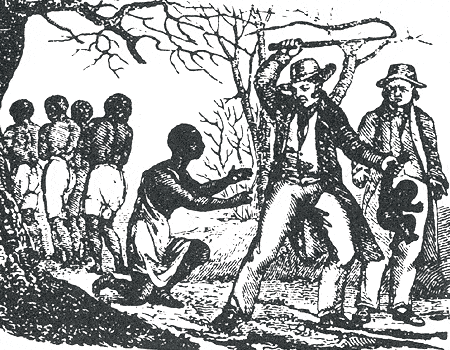
This week, we move from Romanticism as a philosophy and artistic movement toward Romanticism as a social movement. In particular, we'll be looking at how Romanticism with its respect for the individual, its value on heightened ability to feel, and its hope to identify the unique in each person and group helped to form the basis on which one of the first major political reform movements began--Abolitionism.
In the process, you'll read first hand accounts of slavery and discuss current evils in our own society.
As always, write with questions.
Steve
Tuesday, October 20, 2009
Expect the announcments and assignments for the week to be delayed.
I'll be back on a regular teaching and office hour schedule starting tomorrow, Wednesday, 21 October. The tooth which has given me so much trouble over the past week was extracted yesterday. As expected, there is some swelling, sourness, and pain, and my speech is a tad slurred.
Of all my classes, you've felt the impact of this saga the least. The only impact to expect is that your reading and writing for the week will be posted late today or early tomorrow morning rather than this morning. Stay tuned.
Steve
Of all my classes, you've felt the impact of this saga the least. The only impact to expect is that your reading and writing for the week will be posted late today or early tomorrow morning rather than this morning. Stay tuned.
Steve
Monday, October 19, 2009
Just back in from the oral surgeon.
I am just back in the from the oral surgeon. I'm woozy. The numbness from the extraction hasn't worn off. The doctor said everything wend well, but there's no way to predict swelling and pain from recovery. Keep an eye on this space for further announcements. If you hear nothing, assume I'll be keeping regular class meeting times and office hours.
I doubt if I'll be extremely effective today, as the doctor had me take a vicadin as soon as I got home.
Steve
I doubt if I'll be extremely effective today, as the doctor had me take a vicadin as soon as I got home.
Steve
Monday, 19 October
I am having the tooth which has been bothering me extracted this morning, so I will not keep office hours for today, Monday, 19 October.
The last time I had teeth, I was twenty, and they took out two wisdom teeth; so, I have no idea what to expect. Please keep an eye on this announcement page for any announcments affecting office hours or class.
As always you can contact me via email, the "contact me" page, IM, or my home number--885-3727. I don't what kind of position I'll be in to respond today.
Steve
Tuesday, October 13, 2009
Week Eight Assignments and Discussion Starter Are Posted.
Week Eight is designed to allow a space to review, reflect, and assess your learning in the course. If you need to catch up on an assignment, then now is a good time.
Detailed instructions for the assignments this week are posted under Week Eight on the Assignments Tab.
As always, write with questions.
Steve
Detailed instructions for the assignments this week are posted under Week Eight on the Assignments Tab.
As always, write with questions.
Steve
Wednesday, October 7, 2009
MIT...Harvard....Yale...Reynolds CC
Did you know? You are on the cutting edge of education.
http://www.nytimes.com/2009/10/02/education/02blogs.html?_r=1
Steve
http://www.nytimes.com/2009/10/02/education/02blogs.html?_r=1
Steve
Tuesday, October 6, 2009
Week Seven Assignments are Up and the Links Are Hot
The discussion starter and assignments for the week have been posted. This week, make sure to read the essay on the week's reading and how it fits into the larger picture of what you are reading. It is posted below.
Week Seven: "The Sublime Life: Constructing Your Self, Walking, and the Legacies of American Romanticism"
"It is something to be able to paint a particular picture, or to carve a statue, and so make a few objects beautiful; but it is far more glorious to carve and paint the very atmosphere and medium through which we look. To affect the quality of the day– that is the highest of the arts.” --Thoreau, Walden, "Where I Lived, and What I Lived For," HB 1758.
One of the reasons I have come to question the value of the traditional literature class is that such classes do little to help us understand what literature can do for us besides allowing a platform for showing off how smart we think ourselves to be. A class in reading should teach us more. Learning to read literature and use it has little to do with grades or school. If literature has nothing to teach us that we can use to make our lives better, make us happier, or make the lives of others better, by definition it is useless; and, it deserves to be relegated to the trash.
Hence, we read for a number of reasons, but the main ones are the same reasons we go to the gym, namely, to create selves who are better able to live long, happy, constructive lives, and--if we are really lucky--we learn to enjoy the exercise and play we use to construct such a self. We read to exercise our minds and hearts. We read so as to understand ourselves, our world, and others better than we already do. Sometimes this means reading texts and authors which are difficult to understand and who stretch and make sore the emotional and intellectual mussels we use to read and interpret.
No one promised that the ideas which will make life meaningful and worth living will be easy to grasp, nor is life fair enough to present such ideas just when we are ready to hear them; so, we read and practice reading and interpreting so as to be ready with the well-developed interpretative skills we need to recognize the good, usable ideas which are illusive, hard to grasp, and which stretch our thinking to degrees we never thought ourselves capable. As you found over the past several week, learning to get the most out of authors, like Emerson, Thoreau, or Poe can be an exercise in building one's interpretative muscles; such hard reading often pays off in the ideas that make our lives make more sense and allow us to construct lives which are happier and richer than they would be without having struggled through the likes of Emerson, but Emerson is a philosopher king--the Man Thinking.
The main author we will read this week, Henry David Thoreau, is more down to earth and practical than his mentor and friend, Emerson. Thoreau wants to get us thinking, but he wants us to be thinking about how we live our everyday lives and, equally important, how we can construct these lives so we can develop that self we want to be in our heart of hearts. In other words, while Emerson will call for thinkers who were men of Action. Thoreau answers this call. Thoreau wants his readers our living--really living; hence, he writes essays about "Walking" or "Where I Lived and What I Lived For."
Thoreau was one of those rare individuals who knew how to live a good, moral, down to earth life. In every measure which matters, he was a good man. In fact, his life and thinking has inspired other good men, like Gandhi, Martin Luther King and Kennedy, to live better lives; yet, people tend to think of him as some sort of back to nature nut. These folks aren't ready to hear what Thoreau has to say.
Thoreau wants us to be awake to the possibilities life has to offer. That's it.
Walden; or, Life in the Woods, the book from which one of the essays you read a couple of weeks back is taken, "Where I Lived, and What I Lived For," was about two years Thoreau spent in an experiment in which he tried to figure out the absolute minimum one needed to live a life where one was awake to all life has to offer AND capable of enjoying everything life has to offer He goes to the woods, as he says in the paragraph following the one quoted above, to figure out how to "live life deliberately." However, he also goes to the woods because he cares about his readers, and he wants us to live a life as rich as that he experienced while living on Walden pond.
Thoreau decides of living close to nature because he wants to strip away everything which isn't necessary to living a full life, and then build back in only those things which add to a better, even more full life. He also wanted to strip away the things which can get in the way of living a good, happy, spiritually full life, and he firmly believes that getting in touch with your real self is sometimes easier with some solitude, privacy, and time to think. By the way, the reason he leaves Walden pond is that he recognized that the fullest life possible wasn't limited to a cabin in the woods, and he has other things he wanted to explore.
Thoreau doesn't, as many will tell you, want you to head off and live in a cabin in the woods. He's led that life, and he wrote about it so you don't have to go live in the woods. That is, unless this is the life *you* decide you need to live fully and to get from life all it has to offer. Like Emerson, Thoreau thinks that living the good life begins with developing a sense of who you are and who you want to be and then being awake enough to the world and life's possibilities to take advantage of the opportunities and obstacles life offers. (This is why Thoreau spends so much time talking about the wonders of the morning and being fully awake.)
You get to the point of knowing yourself and what you want through visiting with others, working, reading, spending time in nature, thinking and, because one isn't complete without helping others, sharing what you have learned and know to help others make their life better.
One of the rather cool things about Thoreau is he isn't a snob. He doesn't just talk about living; he lives. He is, as Emerson would say, Man Acting. Thoreau knows and lives the fact that you can construct a full life being a farmer, pencil maker, handyman, writer, or anything else, but you have to start with spending the time to figure out what you want and then making sure life itself doesn't get in the way. As the quote above says, this is, according to Thoreau, "the highest of arts."
Over the past couple of months, you've thought about what it means to be an American, about American culture, and about how to define your ideal self to your self and for others. This is, as one of your classmates said, deep stuff.
For Romantic, American Transcendentalist, like Thoreau, Emerson, and the other authors you'll read this week, changing society begins with creating people who are willing and able to change and be their selves first. Being one's self and creating a life where one can be one's self and continue to develop one's self is the greatest challenge facing you as an individual, but the payoff to both yourself and to society is phenomenal. This is the great American challenge and dream, and it is the only pursuit through which American culture can develop its own potential.
Transcendentalist (that is, America's primary brand of Romanticism) were, like most Americans of their time, optimists. They tended to think of others as essentially good. One key to learning to understand others is to realize that few get up in the morning and think, "Today is a good day for me to do evil." Usually, evil happens because people don't understand the consequences of their actions and the limitations of their understanding of the world. Few people, given a choice between acting selfishly and acting in a manner which will help both their selves and their neighbors, will choose to act selfishly. The trick then, at least according to the Transcendentalist, is to figure out for one's self and then to help teach others how we transcend our own ignorance, how we are connected to others and through Nature, and to show--through our own life--how easy and good it is to live well.
Think of this week's reading, that is, Thoreau's essay "Walking" and the selection of poems by several authors as a broad swath of the things which inspired American Romantic writers. Last week you saw how the horror could be used to inspire intense emotion; this is what Poe was about.However, the sublime--those moments of intense emotion where words fail, but you know you are alive--can come from almost any time and place. They can come from Nature, but they can also come from being a nurse to the wounded, thinking about a cable that connects Europe and America, etc. There is no short list of the inspiration which leads one to the sublime.
"Walking," according to Thoreau, is part of the answer to living a good life, and it is one source of the sublime and constructing a sublime life. "Walking," however, is as much about connecting to Nature and using this connection to experience high emotion as it is about the walk. My father used to say, "You don't fish to catch fish. You fish to go fishing."
"Walking" is an essay which talks about getting out into Nature. Thoreau sees walking and nature as a necessary aspects of the full life, that is, a life where you understand why you are here and how to live well. Thoreau is speaking in "Walking" about Nature written large with a capital "N," namely, he is talking about the Wilderness, but he is also speaking about Nature as anything and everything outside of the self. One means of learning to find nature--little "n"-- is learning to walk through it in productive ways. The other secrets of the good life, at least in how Thoreau sees it, are packed into the chapter titles of Walden--which you won't be reading this week--namely, reading, solitude, working, visiting, working with others, etc. In fact, one profitable way to look at Walden is as a discussion of how to live a decent, well constructed life. It is a primer in "the highest of arts."
You'll find your homework in "the highest of arts" in the blog prompt for the week, which asks you to go for a figurative and/or literal walk and to write about it. The class discussion this week will follow up on your blog posts on the sublime from last week. As always, the assignments for the week are spelled out on the "Assignments" page, and you should continue to pay attention to the website's home page for class announcements and hints on doing well in the course.
As always, write with questions.
Steve
One of the reasons I have come to question the value of the traditional literature class is that such classes do little to help us understand what literature can do for us besides allowing a platform for showing off how smart we think ourselves to be. A class in reading should teach us more. Learning to read literature and use it has little to do with grades or school. If literature has nothing to teach us that we can use to make our lives better, make us happier, or make the lives of others better, by definition it is useless; and, it deserves to be relegated to the trash.
Hence, we read for a number of reasons, but the main ones are the same reasons we go to the gym, namely, to create selves who are better able to live long, happy, constructive lives, and--if we are really lucky--we learn to enjoy the exercise and play we use to construct such a self. We read to exercise our minds and hearts. We read so as to understand ourselves, our world, and others better than we already do. Sometimes this means reading texts and authors which are difficult to understand and who stretch and make sore the emotional and intellectual mussels we use to read and interpret.
No one promised that the ideas which will make life meaningful and worth living will be easy to grasp, nor is life fair enough to present such ideas just when we are ready to hear them; so, we read and practice reading and interpreting so as to be ready with the well-developed interpretative skills we need to recognize the good, usable ideas which are illusive, hard to grasp, and which stretch our thinking to degrees we never thought ourselves capable. As you found over the past several week, learning to get the most out of authors, like Emerson, Thoreau, or Poe can be an exercise in building one's interpretative muscles; such hard reading often pays off in the ideas that make our lives make more sense and allow us to construct lives which are happier and richer than they would be without having struggled through the likes of Emerson, but Emerson is a philosopher king--the Man Thinking.
The main author we will read this week, Henry David Thoreau, is more down to earth and practical than his mentor and friend, Emerson. Thoreau wants to get us thinking, but he wants us to be thinking about how we live our everyday lives and, equally important, how we can construct these lives so we can develop that self we want to be in our heart of hearts. In other words, while Emerson will call for thinkers who were men of Action. Thoreau answers this call. Thoreau wants his readers our living--really living; hence, he writes essays about "Walking" or "Where I Lived and What I Lived For."
Thoreau was one of those rare individuals who knew how to live a good, moral, down to earth life. In every measure which matters, he was a good man. In fact, his life and thinking has inspired other good men, like Gandhi, Martin Luther King and Kennedy, to live better lives; yet, people tend to think of him as some sort of back to nature nut. These folks aren't ready to hear what Thoreau has to say.
Thoreau wants us to be awake to the possibilities life has to offer. That's it.
Walden; or, Life in the Woods, the book from which one of the essays you read a couple of weeks back is taken, "Where I Lived, and What I Lived For," was about two years Thoreau spent in an experiment in which he tried to figure out the absolute minimum one needed to live a life where one was awake to all life has to offer AND capable of enjoying everything life has to offer He goes to the woods, as he says in the paragraph following the one quoted above, to figure out how to "live life deliberately." However, he also goes to the woods because he cares about his readers, and he wants us to live a life as rich as that he experienced while living on Walden pond.
Thoreau decides of living close to nature because he wants to strip away everything which isn't necessary to living a full life, and then build back in only those things which add to a better, even more full life. He also wanted to strip away the things which can get in the way of living a good, happy, spiritually full life, and he firmly believes that getting in touch with your real self is sometimes easier with some solitude, privacy, and time to think. By the way, the reason he leaves Walden pond is that he recognized that the fullest life possible wasn't limited to a cabin in the woods, and he has other things he wanted to explore.
Thoreau doesn't, as many will tell you, want you to head off and live in a cabin in the woods. He's led that life, and he wrote about it so you don't have to go live in the woods. That is, unless this is the life *you* decide you need to live fully and to get from life all it has to offer. Like Emerson, Thoreau thinks that living the good life begins with developing a sense of who you are and who you want to be and then being awake enough to the world and life's possibilities to take advantage of the opportunities and obstacles life offers. (This is why Thoreau spends so much time talking about the wonders of the morning and being fully awake.)
You get to the point of knowing yourself and what you want through visiting with others, working, reading, spending time in nature, thinking and, because one isn't complete without helping others, sharing what you have learned and know to help others make their life better.
One of the rather cool things about Thoreau is he isn't a snob. He doesn't just talk about living; he lives. He is, as Emerson would say, Man Acting. Thoreau knows and lives the fact that you can construct a full life being a farmer, pencil maker, handyman, writer, or anything else, but you have to start with spending the time to figure out what you want and then making sure life itself doesn't get in the way. As the quote above says, this is, according to Thoreau, "the highest of arts."
Over the past couple of months, you've thought about what it means to be an American, about American culture, and about how to define your ideal self to your self and for others. This is, as one of your classmates said, deep stuff.
For Romantic, American Transcendentalist, like Thoreau, Emerson, and the other authors you'll read this week, changing society begins with creating people who are willing and able to change and be their selves first. Being one's self and creating a life where one can be one's self and continue to develop one's self is the greatest challenge facing you as an individual, but the payoff to both yourself and to society is phenomenal. This is the great American challenge and dream, and it is the only pursuit through which American culture can develop its own potential.
Transcendentalist (that is, America's primary brand of Romanticism) were, like most Americans of their time, optimists. They tended to think of others as essentially good. One key to learning to understand others is to realize that few get up in the morning and think, "Today is a good day for me to do evil." Usually, evil happens because people don't understand the consequences of their actions and the limitations of their understanding of the world. Few people, given a choice between acting selfishly and acting in a manner which will help both their selves and their neighbors, will choose to act selfishly. The trick then, at least according to the Transcendentalist, is to figure out for one's self and then to help teach others how we transcend our own ignorance, how we are connected to others and through Nature, and to show--through our own life--how easy and good it is to live well.
Think of this week's reading, that is, Thoreau's essay "Walking" and the selection of poems by several authors as a broad swath of the things which inspired American Romantic writers. Last week you saw how the horror could be used to inspire intense emotion; this is what Poe was about.However, the sublime--those moments of intense emotion where words fail, but you know you are alive--can come from almost any time and place. They can come from Nature, but they can also come from being a nurse to the wounded, thinking about a cable that connects Europe and America, etc. There is no short list of the inspiration which leads one to the sublime.
"Walking," according to Thoreau, is part of the answer to living a good life, and it is one source of the sublime and constructing a sublime life. "Walking," however, is as much about connecting to Nature and using this connection to experience high emotion as it is about the walk. My father used to say, "You don't fish to catch fish. You fish to go fishing."
"Walking" is an essay which talks about getting out into Nature. Thoreau sees walking and nature as a necessary aspects of the full life, that is, a life where you understand why you are here and how to live well. Thoreau is speaking in "Walking" about Nature written large with a capital "N," namely, he is talking about the Wilderness, but he is also speaking about Nature as anything and everything outside of the self. One means of learning to find nature--little "n"-- is learning to walk through it in productive ways. The other secrets of the good life, at least in how Thoreau sees it, are packed into the chapter titles of Walden--which you won't be reading this week--namely, reading, solitude, working, visiting, working with others, etc. In fact, one profitable way to look at Walden is as a discussion of how to live a decent, well constructed life. It is a primer in "the highest of arts."
You'll find your homework in "the highest of arts" in the blog prompt for the week, which asks you to go for a figurative and/or literal walk and to write about it. The class discussion this week will follow up on your blog posts on the sublime from last week. As always, the assignments for the week are spelled out on the "Assignments" page, and you should continue to pay attention to the website's home page for class announcements and hints on doing well in the course.
As always, write with questions.
Steve
Wednesday, September 30, 2009
As Promised Some Edgar Allan Poe Extra Credit
Check out the Extra Credit tab for a series of videos you can watch and review for extra credit. This is extra credit you can earn from home; however, later, I'll also post some a couple of local field trips you can take to places in Richmond connected to Poe.
Tuesday, September 29, 2009
Vincent Price Performs "The Tell-Tale Heart"
More than anything else, this is an experiment. Kattar asked me how to include a link to an audio file in his blog, so I am experimenting with adding a video to the blog I use to create announcements for the course. [Kattar, one of the tricks seems to be finding a place online to host your audio file. Let me suggest trying the Internet Archive. Follow the link to "Contributions" at the top of the page.]
Having said this, if you've never seen Vincent Price work with material from Poe, let me encourage you to take fifteen minutes needed to see him perform one of the short stories you are reading this week. You can even watch this video instead of reading "The Tell-Tale Heart." It is that good. It is an extraordinary performance, and Price does an excellent job of capturing the madness of the character.
Here are the two videos:
Having said this, if you've never seen Vincent Price work with material from Poe, let me encourage you to take fifteen minutes needed to see him perform one of the short stories you are reading this week. You can even watch this video instead of reading "The Tell-Tale Heart." It is that good. It is an extraordinary performance, and Price does an excellent job of capturing the madness of the character.
Here are the two videos:
Monday, September 28, 2009
Week Six Asssingments and Discussion Starter are Hot.
Greetings,
This week we read the work of one of Richmond's own--Edgar Allen Poe. Make sure to break up the reading into small chucks. It looks longer than it is because there are many poems and a few short stories in this week's reading. The most difficult piece, the piece you should start early is Poe's essay, "The Philosophy of Composition," where he describes his theory of poetry and why he writes about the subjects and in the way he does. If you've been told Poe was a drunk, a druggie, or mad, make sure to read this essay. Poe was mad, but mad like a fox.
I was able to find etext, wikipedia articles, and audio files for all the week's reading. If I get time over the week and can track down out-of-copyright movies, I'll post links to free, extra credit Poe movies. I will also try to update the extra-credit site with possible Poe trips. It's the 200th anniversary of Poe's brith. He was born in the same year as Lincoln and Darwin. When I put together the Poe extra credit, I'll even throw in a Ghost Tour of Richmond and a tour of the Hollywood Cementary.
This week we read the work of one of Richmond's own--Edgar Allen Poe. Make sure to break up the reading into small chucks. It looks longer than it is because there are many poems and a few short stories in this week's reading. The most difficult piece, the piece you should start early is Poe's essay, "The Philosophy of Composition," where he describes his theory of poetry and why he writes about the subjects and in the way he does. If you've been told Poe was a drunk, a druggie, or mad, make sure to read this essay. Poe was mad, but mad like a fox.
I was able to find etext, wikipedia articles, and audio files for all the week's reading. If I get time over the week and can track down out-of-copyright movies, I'll post links to free, extra credit Poe movies. I will also try to update the extra-credit site with possible Poe trips. It's the 200th anniversary of Poe's brith. He was born in the same year as Lincoln and Darwin. When I put together the Poe extra credit, I'll even throw in a Ghost Tour of Richmond and a tour of the Hollywood Cementary.
Tuesday, September 22, 2009
The assignments and discussion threads for week five are posted.
The reading, writing, and discussion threads for week five are hot.
Steve
Steve
Friday, September 18, 2009
About This Week: Emerson's "The American Scholar" and the Big Picture
Originally, Emerson write the essay, "The American Scholar," as a speech for Phi Beta Kappa Society, at Cambridge. The year was 1837; that is, it was just fifty years since America adopted it current Constitution in 1787. America was a very young country. It was rapidly expanding, but it still looked to Europe for most of its culture and intellectual tradition.
In part, this continued dependence on Europe and, in specific, England as the primary source of our culture was what Emerson was reacting to. America was just at the tipping point in terms of being able to support professional authors. Publishing was just coming out of the hand presses and moving toward machine production. Most important, paper was, for the first time in history, relatively cheap. The nation and the world was primed for cheap newspapers and a mass market for books and ideas.
Since books, printing, and writing were the only means in existence for easily capturing entertainment. Remember, this was well before Edison's invention of the phonograph or the advent of radio. This moment when all came together to produce relatively cheap books, which everyone could afford was an important moment. Equally important, America had a decision to make. It was prior to international copyright, and most publishers in America could by a single book in England and then reprint it in America without paying the author or the original publisher. This made European books much cheaper to publish, because publishers didn't have to pay what they had to pay American authors, who were protected by copyright.
"The American Scholar" has been called America's intellectual and cultural Declaration of Independence. In part, this is true because Emerson was calling on the students to whom he was speaking in his address to become the thinkers and writers American needed to make a cultural break with England in the same way it had made a political break in 1776. The problem was a hard one. How does one go about establishing a new national intellectual tradition and a new culture? This is not a problem which often presents itself. The other reason Emerson's essay is considered a milestone is that he lays out a road map for what and how his audience needs to study and write about to create a distinctly American culture.
In part, this continued dependence on Europe and, in specific, England as the primary source of our culture was what Emerson was reacting to. America was just at the tipping point in terms of being able to support professional authors. Publishing was just coming out of the hand presses and moving toward machine production. Most important, paper was, for the first time in history, relatively cheap. The nation and the world was primed for cheap newspapers and a mass market for books and ideas.
Since books, printing, and writing were the only means in existence for easily capturing entertainment. Remember, this was well before Edison's invention of the phonograph or the advent of radio. This moment when all came together to produce relatively cheap books, which everyone could afford was an important moment. Equally important, America had a decision to make. It was prior to international copyright, and most publishers in America could by a single book in England and then reprint it in America without paying the author or the original publisher. This made European books much cheaper to publish, because publishers didn't have to pay what they had to pay American authors, who were protected by copyright.
"The American Scholar" has been called America's intellectual and cultural Declaration of Independence. In part, this is true because Emerson was calling on the students to whom he was speaking in his address to become the thinkers and writers American needed to make a cultural break with England in the same way it had made a political break in 1776. The problem was a hard one. How does one go about establishing a new national intellectual tradition and a new culture? This is not a problem which often presents itself. The other reason Emerson's essay is considered a milestone is that he lays out a road map for what and how his audience needs to study and write about to create a distinctly American culture.
Wednesday, September 16, 2009
I will be keeping virtual office hours today, Wednesday, 16 September
I will be keeping virtual office hours today. What this means is that I am still available for meeting, but I won't base myself in my office. If you need to arrange an in person meeting today, please email--I'll have it open between 9:00 and 1:00 or IM, which will also be open. We'll arrange the meeting through the IM or email, or we can take care of any business through IM or email. It is your choice.
Steve
Steve
Tuesday, September 15, 2009
Week Four discussion starter and threads are now up, as are the assignments for the week.
What the title says.
As always, write with questions.
Steve
As always, write with questions.
Steve
Tuesday, September 8, 2009
Week Three Assignments and Discussion Threads are Now Hot...
I've activated the links off the assignment page to the week's assignments and discussion threads.
Over the weekend, I threw out my back, so I am on bed rest for two or three days. I will *not* keep office hours on Wednesday, 9 September.
As always, write with questions.
Steve
Over the weekend, I threw out my back, so I am on bed rest for two or three days. I will *not* keep office hours on Wednesday, 9 September.
As always, write with questions.
Steve
Saturday, September 5, 2009
Exceptional Letters on "What is an American?"
Since I first developed this assignment as a way to start the course, I've read a *lot* of these letters. It is always a privilege and a joy, but this semester it has been more so than most. I'm now going in and leaving individual comments on each of your blogs--look just under your post on your blog for "comments." [I will try to have this commenting done early next week.] I won't leave comments on everything you write on your blog or the forums, but I will when what you say is particularly good or you are wandering off the mark and writing stuff which won't help you get the high grade you want to earn and which I want to give you. I will also rather shamelessly take advantage of any opening I can find to teach or correct a misapprehension.
However, I am getting sidetracked, I wanted to let you know this class wrote particularly beautiful, insightful letters for the assignment, and you were able to capture the same spirit of wonder and admiration for the people and land which de Creveceour tried to do in the late 1800s. As you think about your letter and de Creveceour, think about this: he didn't have two hundred plus years of people talking about what Americans are to help him. He started this tradition, and what he had to say helped to form how we think of ourselves as a people. In fact, his writing has been used more than once in Supreme Court decisions as a means of figuring out what the founders wanted America to become.
In reading your letters, one of our class mate's letters was particularly striking, and I thought I'd share an excerpt for those not in Khattar's group:
Class...keep up the kind of thinking and writing you demonstrated this past week, and this is going to be a truly remarkable semester.
PS The next time you find yourself in a conversation about immigration, remember Khattar's words. This nation was built by immigrates, that is, if we weren't already here, like my Cherokee ancestors. Me? I'm Cherokee and Scottish and German and proud of most of them, even the Ozark hillbilly, rednecks who couldn't stay out of gun fights.
However, I am getting sidetracked, I wanted to let you know this class wrote particularly beautiful, insightful letters for the assignment, and you were able to capture the same spirit of wonder and admiration for the people and land which de Creveceour tried to do in the late 1800s. As you think about your letter and de Creveceour, think about this: he didn't have two hundred plus years of people talking about what Americans are to help him. He started this tradition, and what he had to say helped to form how we think of ourselves as a people. In fact, his writing has been used more than once in Supreme Court decisions as a means of figuring out what the founders wanted America to become.
In reading your letters, one of our class mate's letters was particularly striking, and I thought I'd share an excerpt for those not in Khattar's group:
I also am an immigrant and I asked myself the same questions ten years ago. I came here with my wife and daughter because I wanted to provide them with a safe lifestyle and give them the things I couldn’t in my home-country. We came here with enough money to just get by and with a little hard work and determination, we are now proud to call America, home.This is remarkable writing, and Khattar captures what it means to be an American, that is, not only to live in a land where opportunity and basic freedoms are built into the system of government, but to be inspired and motivated by this opportunity and freedom to make a better living for yourself and your family AND to then reach out to your neighbors to help them through tough times. I know of few other systems which make it so easy to help others by making yourself better.
Over the years you will learn that this country is right for those who value a fair and just law. It is right for those who put in an effort to get to know the names of their neighbors and for those who offer a helping hand in times of need. Anybody who’s lived a day on this earth can testify that there will always be times of need.
You will experience in America a prosperity that will motivate you for the future. You will also find that the system here supports a growing population. If you have the dream, America is the country that allows you to transfer it into reality; into ideas for the future, into thoughts of art and science.
Class...keep up the kind of thinking and writing you demonstrated this past week, and this is going to be a truly remarkable semester.
PS The next time you find yourself in a conversation about immigration, remember Khattar's words. This nation was built by immigrates, that is, if we weren't already here, like my Cherokee ancestors. Me? I'm Cherokee and Scottish and German and proud of most of them, even the Ozark hillbilly, rednecks who couldn't stay out of gun fights.
Thursday, September 3, 2009
Your Committee Assignments Are Now Updated
Greetings,
Everyone is now assigned to their committee of correspondence. Check out to "General Assembly" page to see your assignment, and to read and comment on your committee members' blogs and posts.
Thank you for those who let me know of the miss and/or broken links. If you haven't, make sure to check your contact informantion and the link to your blog to make sure they are correct. Let me know if they aren't.
Steve
Everyone is now assigned to their committee of correspondence. Check out to "General Assembly" page to see your assignment, and to read and comment on your committee members' blogs and posts.
Thank you for those who let me know of the miss and/or broken links. If you haven't, make sure to check your contact informantion and the link to your blog to make sure they are correct. Let me know if they aren't.
Steve
Saturday, August 29, 2009
Welcome.
Welcome to Early American Literature.
Take a good long look at the syllabus, and write me with any questions. In the syllabus, I explain each aspect of the reading and writing for the class, what you'll be doing each week, how you'll be graded, and I go over the class and college policies--like the "Ouch Rule"--under which the class will run.
Next, take a look at the "Assignments" tab. Here, you will find detailed instructions on the reading and writing for any particular week. You might also want to look at the "Extra Credit" tab to see how you can earn extra credit as you do your regular class work.
Next, take a look at the "General Assembly." This is where you'll go to contact me and to participate in class and group discussions.
Finally, notice the "Contact Me" tab. It will give you more information than you ever wanted to know about getting in touch with yours truly. The best way to get in touch is to use the many "Contact Me" and "Question?" forms scattered around the class website, but you've also got email, phone (office & home), and IM. I'm here to help you learn and succeed. Indeed, the key to success in an online course is staying in communication, asking questions, and helping me to help you.
As always, write with questions.
Steve
Take a good long look at the syllabus, and write me with any questions. In the syllabus, I explain each aspect of the reading and writing for the class, what you'll be doing each week, how you'll be graded, and I go over the class and college policies--like the "Ouch Rule"--under which the class will run.
Next, take a look at the "Assignments" tab. Here, you will find detailed instructions on the reading and writing for any particular week. You might also want to look at the "Extra Credit" tab to see how you can earn extra credit as you do your regular class work.
Next, take a look at the "General Assembly." This is where you'll go to contact me and to participate in class and group discussions.
Finally, notice the "Contact Me" tab. It will give you more information than you ever wanted to know about getting in touch with yours truly. The best way to get in touch is to use the many "Contact Me" and "Question?" forms scattered around the class website, but you've also got email, phone (office & home), and IM. I'm here to help you learn and succeed. Indeed, the key to success in an online course is staying in communication, asking questions, and helping me to help you.
As always, write with questions.
Steve
Subscribe to:
Posts (Atom)
Subscribe To


 Posts
All Comments
Posts
All Comments